
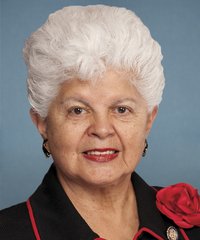
Congresswoman Grace Flores Napolitano represents California’s 32nd District. Her Los Angeles County-based district covers several cities and communities in the San Gabriel Valley – El Monte, West Covina, Covina, Baldwin Park, Azusa, Duarte, Irwindale, Industry, La Puente, Avocado Heights, West Puente Valley, Valinda, Glendora, San Dimas, La Verne and Monrovia.
Napolitano is the highest-ranking California member and Hispanic member of the U.S. House Committee on Transportation & Infrastructure where she currently serves as Chairwoman on the Subcommittee on Water Resources and Environment, which oversees EPA’s Clean Water Act and US Army Corps of Engineers water programs.
Napolitano was appointed by Democratic Leader Nancy Pelosi under the direction of Vice President Joe Biden to serve as a Vice-Chair of the House Democratic Gun Violence Prevention Task Force, following the tragic shooting at Sandy Hook Elementary in Newtown, CT. Her main focus on the task force is the intersection of mental illness and gun violence, most notably suicide prevention.
In January 2016, Napolitano met with President Obama, fellow Task Force members, and other Democratic colleagues, to dialogue on possible executive actions. She then joined the President at the White House on January 5, 2016, for his announcement of new executive actions to curb gun violence and make communities safer. Napolitano ensured that adding mental health services was a component of those comprehensive actions to prevent senseless gun deaths. She remains strongly committed to expanding background checks and other measures to keep firearms out of the hands of those who might use them to harm themselves or others.
Congresswoman Napolitano is the founder and Co-Chair of the Congressional Mental Health Caucus, where she promotes access to mental health for children and adolescents, improved mental health resources for veterans and seniors, and increased mental health coverage for all. After learning one in three Latina adolescents (ages 9-11) had contemplated suicide, in 2001 she secured federal funding to create a pilot program to provide on-site, culturally and linguistically appropriate mental health services and suicide prevention services for students. With assistance from LA County Department of Mental Health, her successful program, which began in four schools, has now expanded to 35 schools throughout the San Gabriel Valley and Southeast LA County. It now serves as a model for H.R. 721, the Mental Health Services for Students Act. Napolitano also works closely with the 32nd District Mental Health Consortium, a dedicated group of local mental health professionals and advocates who advise the Congresswoman on public mental health policy and related issues.
Napolitano has been very active in securing mental health parity in the Affordable Care Act, promoting mental health legislation, and working with prominent figures to increase funding and access to mental health services. After the tragic Newtown shooting, in 2013 Napolitano was appointed to serve as vice-chair of the House Democratic Gun Violence Prevention Task Force to ensure mental health remained a critical part of the conversation on gun violence prevention.
Napolitano remains committed to continuing to reduce the harmful stigma related to mental illness and educating public officials, communities, and families on warning signs and symptoms and that it is ok to seek help.
Napolitano is the most senior California member and Hispanic member of the U.S. House Committee on Transportation & Infrastructure where she currently serves as Chairwoman on the Subcommittee on Water Resources and Environment, which oversees EPA’s Clean Water Act and US Army Corps of Engineers water programs.
On that panel, Napolitano works with the Corps, local flood control districts, and water agencies to capture more water in flood control reservoirs, which is a major issue at Santa Fe Dam in her district and the bordering Whittier Narrows Dam. In 2014 she was appointed as a conferee to finalize the Water Resources Reform and Development Act (WRRDA), providing more equity to the Ports of Los Angeles and Long Beach in dredging operations. She also secured important provisions for L.A. County to expand water supply, flood control, and recreation projects in the region. Napolitano supports both the Los Angeles River Revitalization Plan and improvements to the San Gabriel River with environmental restoration projects and recreational opportunities, such as bikeways, fishing, and swimming areas.
Napolitano also encourages the EPA and sanitation agencies to find ways to recycle water for irrigation use and groundwater replenishment. She closely monitors the implementation of a new Clean Water Act Stormwater Permit, ensuring affordability for L.A. County cities and residents.
In fall of 2015, Napolitano became the only California Democrat appointed to finalize the recently passed FAST Act (H.R. 22), a $305 billion 5-year transportation bill for the nation. Napolitano fought to secure more than $26 billion for California, $450 million of which going to the Los Angeles region for transit funding, benefiting Foothill Transit, LA Metro, and Metrolink. Funds will also relieve congestion, improve transit, and reduce the negative impacts her district takes on as a primary shipping corridor from the Ports of Long Beach and Los Angeles.
Our veterans have served us honorably, and they deserve nothing less than the same dedication from us.
Rep. Grace F. Napolitano is a strong advocate for securing clean, inexpensive water supply that we can rely on even in times of drought. She has fought for increased water recycling, improved water conservation, and environmental protections for our natural sources of drinking water.
Napolitano has recently coauthored two bipartisan bills to assist with the Los Angeles County Municipal Separate Storm Sewer System (MS4) permit from the State Regional Water Quality Control Board:
1. H.R. 2355, the Water Infrastructure Flexibility Act, would provide regulatory flexibility and affordability assistance to cities with the implementation of Clean Water Act permits. It is supported by the U.S. Conference of Mayors, the National League of Cities, and the National Association of Counties.
2. H.R. 2510, the Water Quality and Job Creation Act, provides funds to support cities in implementing the LA County MS4 permit, as well as improve water supply infrastructure to manage future droughts. The bill provides $4.85 billion in EPA grants and $20 billion in EPA loans for cities and local agencies to construct storm water projects, water recycling and reuse projects, groundwater recharge projects, and water pollution control projects.
In 2010, Napolitano introduced H.R. 4349, the Hoover Dam Power Allocation Act, which would authorize the Hoover Dam to continue operating for another 60 years and give Native American tribes and other groups new access to its power. The Hoover Dam provides electricity for 29 million people, and Lake Mead, the body of water behind the dam, is a critical source of water for millions of Californians. President Obama signed the legislative language into law on Dec. 20, 2011.
Napolitano has been a long-time champion for cleaning up local groundwater and making it safe to drink. She has helped secure more than $80 million in federal funds for the San Gabriel Basin Restoration Fund, which pumps water out of the ground at several San Gabriel Valley Facilities and removes chemical contaminants potentially hazardous to human health.
Since 1999, Napolitano has worked to ensure the removal of a dangerous, 16 million-ton mass of uranium waste near the Colorado River in the town of Moab, Utah. This heap of uranium waste was leeching into the river and posed a health threat to the 38 million people in California, Nevada, Arizona, and other western states who get their water from the Colorado River. Napolitano supported increased clean-up funding which was included in the American Recovery and Reinvestment Act, and to date 4.5 million tons have been safely disposed of, with cleanup estimated to be finished in 2019.
Napolitano has also opposed efforts to weaken clean water regulations. In 2011, she opposed H.R. 2018, the Clean Water Cooperative Federalism Act, which would have lowered national clean water standards. She believes environmental water regulations that protect human health should remain strong and our drinking water must be kept free from contamination.
Napolitano is a member and former top Democrat on the House Committee on Natural Resources’ Subcommittee on Water, Power, and Oceans. She has served on the Natural Resources Committee throughout her tenure in Congress.
The United States Congress in 1993 mandated the National Guard Bureau to design a federal program to address the millions of children who have dropped out of high school. The result is a joint federal-state partnership called the National Guard Youth ChalleNGe Program (NGYCP) that has produced extraordinary results. Since 1993, this program has helped over 140,000 of our nation’s high school dropouts become productive. This voluntary 22-week program enhances life skills, education levels, employment potential, and prospects for the future by providing the assistance, training and opportunity for students to earn their high school diploma or GED, at no cost to the young person’s family. The dedicated National Guard cadre, teachers, volunteer parents and mentors provide a strong level of discipline, life skills, and leadership training coupled with a high educational component. There are 40 programs located in 28 states, Washington, DC and Puerto Rico.
Studies
1. A study by the MDRC in July 2011 stated that ChalleNGe participants achieve “impressive results” in educational attainment and employability. Participants are 29 percent more likely to earn a high school diploma or GED and 86 percent more likely to take college courses and earn approximately 20 percent higher wages than dropouts who do not participate in ChalleNGe.
2. RAND Corporation in February 2012 conducted a cost-benefit analysis, based on the MRDC study of ChalleNGe. RAND found that every dollar spent on the program results in a return of $2.66, a yield of 166 percent return on investment. These rigorous evaluations show significant positive impacts by the ChalleNGe on the lives of those who have dropped out of school, with compelling returns on investment.
Cong. Youth ChalleNGe Caucus
The Congresswoman is a co-chair of the National Guard Youth ChalleNGe Caucus, along with her Republican counterpart Congressman David McKinley (WV-01). The caucus provides a forum for Members of Congress and their staff to learn more about this program and work towards solutions to address the epidemic of high school dropouts.
California Programs
California has three NGYCP’s: the Sunburst Youth Academy located on the Joint Forces Training Base in Los Alamitos, the Grizzly Youth Academy is located at Camp San Luis Obispo, and the recently opened Discovery ChalleNGe Academy in Stockton. Sunburst/Grizzly/Discovery accommodates 550+ resident students in five and a half month cycles, providing physical training, discipline and academics throughout the entire program. California’s programs have graduated over 7000 cadets. Recent statistics:
CBS Evening News w/ Scott Pelley
Recently produced a 7 part series on the Sunburst Youth Academy, which can be seen here:
I hold community events throughout the year to hear from my constituents and provide important information on current issues.
Learn about district projects in California's 32 district.
It is critical to make the necessary investments to grow our economy and create jobs.
We must give our young people the education they need to be successful adults.
The environment is an important issue to my work in Congress.
Financial services must be fair to consumers and beneficial to the larger economy.
Determining the best way to ensure high-quality, affordable health care is an important part of my work in Congress.
Affordable housing and relief for homeowners are critical for a stable and prosperous community.
We need comprehensive immigration reform that fixes our broken system and works for all of America.
We need a justice system that is fair and impartial.
Local news and honors from across our district.
A capable military is critical for the safety of our country