
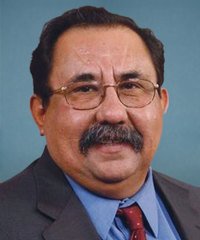
Raúl Grijalva began his career in public service as a community organizer in Tucson. Four decades later, he continues to be an advocate for those in need and a voice for the constituents of his home community. From 1974 to 1986, Raúl served on the Tucson Unified School District Governing Board, including six years as Chairman. In 1988, he was elected to the Pima County Board of Supervisors, where he served for the next 15 years, chairing the Board for two of those years. Raúl resigned his seat on the Board of Supervisors in 2002 to seek office in Arizona’s newly created Seventh Congressional District. Despite a nine-candidate primary and the challenge of being outspent three-to-one by his closest competitor, Raúl was elected with a 20-point victory, thanks to a diverse coalition of supporters that led the largest volunteer-driven election effort in Arizona.
I believe that the Supreme Court's decision in Citizens United V. FEC went far beyond precedent, far beyond the original intent of the Constitution, and far beyond anything the Founders meant when they protected freedom of speech for individuals. James Madison never intended for the First Amendment to apply to corporations; he meant free speech to be for the people.
As it stood, the Bipartisan Campaign Reform Act that was destroyed by the Supreme Court did not take away access to political speech by corporations. A corporation could have spent unlimited sums of money to televise and broadcast its message at any time except immediately before primaries and general elections. This limited law was directed at keeping wealthy corporate interests from drowning out the voice of individuals just before a vote. The idea that corporations must be treated identically to human beings when it comes to political speech is a bad reading of history and an insult to the people of this country.
This ruling was a power grab by conservative judicial activists unnecessarily overturning more than a century of judicial precedent. I believe that Congress must address this inflation of corporate power to return the electoral process back to the American people.
In addition, I support a two-tiered strategy for dealing with the effects of this decision. Because the Supreme Court based its decision on sweeping constitutional protections, the decision can only be directly addressed by a constitutional amendment outlining the principle that corporations are not people as far as First Amendment freedom of speech is concerned.
The short-term strategy must address the ways in which corporate money overpowers outside ideas and opinions. We must ensure that any corporation wishing to make political contributions or advocate any candidate, party or cause gets the express permission of the shareholders whose money they are spending. We must also ensure that foreign corporate influence is not permitted to sway our elections with expensive messaging. Corporations that produce ads meant to sway voters should be made to identify themselves and any shadow corporations behind the expenditures.
These efforts will help to minimize the negative effects of the outrageous decision of the Supreme Court, a decision that granted an unwarranted expansion of corporate expenditure to influence the political process in ways that cannot be matched by individuals.