
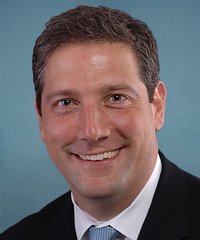
Tim Ryan is a relentless advocate for working families in Ohio's 13th District. He was first elected to the U.S. House of Representatives in 2002 and was sworn in on January 3, 2003. Successfully reelected nine times, he is now serving in his tenth term. Congressman Ryan currently serves as a member of the powerful House Appropriations Committee which controls the expenditure of money by the federal government.
Ryan serves as co-chairman of the Congressional Manufacturing Caucus and remains a leader in the fight to strengthen America's manufacturing base and reform U.S. trade policies. The House Manufacturing Caucus examines and promotes policies to help American manufacturers find trained, educated workers, continue to lead the world in developing new industrial technologies, operate on a level playing field with their foreign competitors, and obtain the capital they need to thrive. Ryan is the leading advocate in the House to impose sanctions on unfair Chinese currency manipulation.
A prescription drug and heroin epidemic is currently sweeping our state and the nation. Opioid deaths have surpassed 30,000 for the first time in history. I have personally seen tragedy play out in our community due to the readily available nature of these drugs. In Ohio, fatal drug overdoses have been the leading cause of accidental death since 2007, with heroin-involved deaths rising from 16 percent of all drug overdoses in 2008 to 22 percent in 2010. These numbers are unacceptable, and more needs to be done to stem the ever-growing tide. As Co-Chair of the Congressional Addiction, Treatment and Recovery Caucus and member of the Bipartisan Task Force to Combat the Heroin Epidemic, I have made it my priority to educate and raise awareness about the dangers of heroin and opioid abuse.
Substance abuse costs our nation $600 billion in health care, criminal justice, and lost productivity costs, but that is nothing compared to the toll it takes on our families and friends. We cannot continue to allow heroin and prescription drugs to wreak havoc on our communities. There is no simple answer to how we combat this public health crisis, and we must treat addiction as a disease and respond accordingly. It needs to be a comprehensive approach that combines law enforcement, prevention, treatment, recovery support, overdose reversal and criminal justice initiatives.
In the 114th Congress, I introduced the Comprehensive Addiction and Recovery (CARA) Act to provide for a robust response to the heroin and prescription drug epidemic through prevention, law enforcement strategies, and the expansion of evidence-based treatment. I am proud that President Obama signed this important piece of legislation into law.
The Comprehensive Addiction and Recovery Act of 2016 expands prevention and educational efforts to prevent the abuse of opioids, increases the availability of naloxone to law enforcement agencies and other responders, and strengthen prescription drug monitoring programs to help states monitor and track prescription drug diversion and to help at-risk individuals access services. Furthermore, it creates a grant program to states to carry out a comprehensive opioid abuse response, reauthorizes a grant program for residential treatment for pregnant and postpartum women who have an opioid-use disorder and for their children, and expands prescription drug take-back programs. I was happy to continue this work in the 115th Congress with the introduction of CARA 2.0, which builds on the effort authorizes new funding and programs to combat this ongoing problem.
Right now, 2.1 million Americans abuse prescription pain relievers, yet only 1 in 10 gets treated. I believe we must make substance abuse treatment more accessible and affordable for anyone who makes the courageous decision to get help. That is why Congresswoman Marcia Fudge (OH-11) and I have introduced the Breaking Addiction Act, which would increase access to treatment by repealing the archaic IMD Exclusion once and for all and opens up treatment for those men and women who need it.
We need to make sure we are doing everything in our power to protect the most vulnerable and innocent victims of this epidemic – infants. That is why I cosponsored the Protecting Our Infants Act, which creates a report on prenatal opioid abuse and neonatal abstinence syndrome, and develops strategies to address gaps in research and programs. I was proud this legislation became law in 2015.