
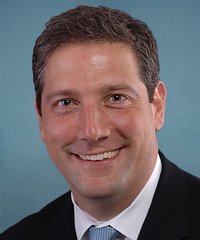
Tim Ryan is a relentless advocate for working families in Ohio's 13th District. He was first elected to the U.S. House of Representatives in 2002 and was sworn in on January 3, 2003. Successfully reelected nine times, he is now serving in his tenth term. Congressman Ryan currently serves as a member of the powerful House Appropriations Committee which controls the expenditure of money by the federal government.
Ryan serves as co-chairman of the Congressional Manufacturing Caucus and remains a leader in the fight to strengthen America's manufacturing base and reform U.S. trade policies. The House Manufacturing Caucus examines and promotes policies to help American manufacturers find trained, educated workers, continue to lead the world in developing new industrial technologies, operate on a level playing field with their foreign competitors, and obtain the capital they need to thrive. Ryan is the leading advocate in the House to impose sanctions on unfair Chinese currency manipulation.
Protecting our economy and putting citizens back to work is one of my top priorities as a Member of Congress. We need to take an innovative approach to legislation that will grow the economy, reward businesses that keep jobs in the United States, reduce the deficit, and create a level playing field for American workers in the global market.
It is essential we do all we can to strengthen and protect manufacturing, a vital American industry and the foundation of our economy. When manufacturers are given the tools they need to compete in a global marketplace, Americans prosper and our nation becomes stronger. Manufacturing employs 662,000 Ohioans and contributes $99.8 billion to our state's economy. In our district alone, we have more than 600 manufacturing companies employing nearly 37,000 workers. Most recently, manufacturers have lost on average 74,000 jobs per month, good-paying jobs that pay an average of 20 percent more than typical service sector jobs.
As Co-Chair of both the House Manufacturing Caucus and the House Maker Caucus, I am dedicated to promoting and expanding American manufacturing. I have introduced legislation to establish the position of U.S. Chief Manufacturing Officer in the Executive Office of the President. The U.S. Chief Manufacturing Officer (CMO) will be responsible for coordinating manufacturing-related policies and activities across agencies. The CMO will also develop a national strategy to revitalize the manufacturing sector, spur economic growth, and increase our competitiveness around the globe. Manufacturing is the stabilizing force behind our local and national economy. Without a strong domestic manufacturing base, we will not have a strong economic recovery.
Each and every day, I hear stories from constituents who have been negatively impacted by free trade agreements that ship manufacturing jobs overseas. When plants are closed and friends and family lose a reliable source of income, it has a profound rippling effect that impacts every part of our community. All workers ask for is a level playing field so they can compete on a global scale. However, past trade agreements have not lived up to those standards, and I have consistently opposed them while in Congress. That is why I voted against the Panama, Colombia, and South Korea free trade agreements and the Trans-Pacific Partnership (TPP). Furthermore, I have testified before the International Trade Commission to voice my concern about predatory behavior of countries such as China that continues to dump steel and aluminum products on our shores at government subsidized below-market prices. It is my belief that hardworking Americans deserve better when it comes to our country's trade policy.
Future of manufacturing rests with our ability to innovate. We must invest in innovation in manufacturing, so new industries and jobs can flourish. In 2012, a landmark $85 million public-private investment was made in Northeast Ohio. The joint venture, America Makes, was the first major investment to help revitalize American manufacturing by investing in "additive manufacturing" which relies on 3D printers to build components layer-by-layer rather than subtractive processes like milling. More than 20 collaborative research projects are under way and Northeast Ohio is already seeing the benefits with companies coming to Youngstown, Akron, and Cleveland. This investment is helping the U.S. grow its capabilities in additive manufacturing; but unfortunately, experts estimate that American spending only amounts to about one-third of what China is investing in in the same industry.
There is no doubt we must do more to help educate the next generation for careers in manufacturing. Science, technology, engineering and math (STEM) education helps drive our nation's economic train and ensures our children will be prepared to lead the world in innovation and entrepreneurship. That is why I have introduced the 21st Century Shop Class Act, which promotes maker education and will help gives students the skills they will need to participate in the exciting jobs that require knowledge of new tools, such as computer programming, engineering analysis, 3-D printing, and robotics. I have also cosponsored the Stepping up to STEM Education Act and the Women and Minorities in STEM Booster Act to help expand and increase the participation in STEM programs. As Americans we have always valued education, and we have had a strong appetite for innovation and entrepreneurship. This is even more important today as the competition for manufacturing and jobs has truly become global. We need educated citizens that will be ready to build a better and brighter future for the United States of America.