
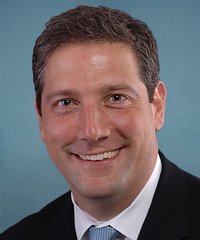
Tim Ryan is a relentless advocate for working families in Ohio's 13th District. He was first elected to the U.S. House of Representatives in 2002 and was sworn in on January 3, 2003. Successfully reelected nine times, he is now serving in his tenth term. Congressman Ryan currently serves as a member of the powerful House Appropriations Committee which controls the expenditure of money by the federal government.
Ryan serves as co-chairman of the Congressional Manufacturing Caucus and remains a leader in the fight to strengthen America's manufacturing base and reform U.S. trade policies. The House Manufacturing Caucus examines and promotes policies to help American manufacturers find trained, educated workers, continue to lead the world in developing new industrial technologies, operate on a level playing field with their foreign competitors, and obtain the capital they need to thrive. Ryan is the leading advocate in the House to impose sanctions on unfair Chinese currency manipulation.
We must improve and expand our children's opportunity to access a quality education in in the United States of America. Investing in education is an investment into our economy, our quality of life and most importantly it is an investment into our children's future.
It is our responsibility in Congress to improve and expand our children's opportunity to access a quality education in in the United States of America. Investing in education is an investment into our economy, our quality of life and most importantly it is an investment into our children's future. Advancements in childhood nutrition, after-school programs, technology in schools, as well as teacher salaries, recruitment and training must be a priority for success. We have seen how severe state and federal budget cuts undermine the ability of our local school districts to provide a quality education for our children; this has resulted in overcrowded and dilapidated schools, overburdened and stressed teachers, increased class sizes, and inadequate support services like special education, after-school care and preschool programs. That is why I have continually voted against legislation that would make drastic cuts to our children's education.
As a father and the husband of an elementary school teacher, I understand the need for Congress to improve education and ensure equal access to a quality education. That is why I supported the bipartisan Every Student Succeeds Act (ESSA), which includes commonsense provisions that ensure our young people get the education they deserve. This legislation gives states greater power to close the achievement gap for disadvantaged students, reduces overreliance on standardized testing, and gives teachers and schools the resources they need to be successful.
In the last few years, I have become convinced of the necessity of teaching social and emotional learning skills to our children, and have worked with some great leaders in bringing the financial and intellectual skills and expertise to Youngstown and Warren City Schools. Social and emotional learning is a process that promotes the development of core personal competencies: self-awareness, self-management, social awareness, relationships skills, and responsible decision-making – all within a safe, caring, and participatory learning environment.
In 2011, I introduced the Academic, Social and Emotional Learning Act to allow federal funding for teacher and principal training to be used for SEL programming. As we have seen in schools in our district, SEL helps increase attendance, decrease suspensions and behavioral incidences, and improve attention and participation among students. Creating a healthy and safe environment for students to learn is essential to a quality education. I was proud that language that will help expand and make the teaching of social and emotional learning more effective was included in the ESSA. Creating a healthy and safe environment for students to learn is essential to a quality education and I am proud this bill continues to advance this important cause. I will continue to support legislation that helps our young people both boost their academic potential and teach them how to build the relationships and skills necessary to be a productive member of the American workforce.
Ohio is home to nearly 400 taxpayer-funded charter schools that educate approximately 123,000 students. These families and children deserve a charter school system that promotes transparency and is held accountable to make sure every student is receiving the best education. That is why I introduced the Charter School Accountability Act to increase transparency and oversight of the U.S. charter school system. I was pleased that the ESSA strengthens the accountability and transparency within the charter school program, including language from this bill. Ohio students attending charter schools, and their parents, should never have to worry if they are getting the education they are owed.
Education does not stop after high school and we need to improve equality and access at the college level as well. College costs are increasing at a much faster rate than the financial aid given to students and their families. Since 1978, the cost of college tuition has increased by an astounding 1200%, with no real end in sight. Our students are drowning in the debt they were forced to take on to cover these rising costs, and they are too often saddled with tremendous debts long after they complete their education. To make interest rates for college students more affordable, I cosponsored the Bank on Students Emergency Loan Refinancing Act, which allows borrowers with existing student loans to refinance at the lower interest rates available to new borrowers. Student borrowers should not have to wait for relief when they need help now.
We must do more to help raise awareness and educate our children on how to eat healthier both at home and at school. Most children consume a least half of their meals at school, with more than 32 million participating in the National School Lunch Program and more than 12 million participating in the School Breakfast Program. Research shows that children are much more likely to consume healthy fresh food if there is a salad bar available for children to build and create their own meal. However, the upfront cost of acquiring the equipment and the investment in planning and administering a salad bar can be too costly for most schools to undertake with existing resources. That is why I introduced the Salad Bars in Schools Act, which supports creating a grant program that would allow schools to work with existing non-profits that promote getting more salad bars into our children's schools.